Rhamnolipid research
Explore biological surfactant chemistry and potential applications.
A focused look at rhamnolipids, biosurfactant research and the evaluation of treatment methods and residual effects under defined experimental conditions.
Matter is anything that has mass and occupies space. Here, “matter” means physical substances and materials—including solids, liquids, gases, and biological materials—not the everyday expression “what does it matter?”
Biosurfactants research concerns physical substances, including formulations and materials under study for treatment applications. Performance and suitability depend on the formulation, application, and validation conditions.
Explore biological surfactant chemistry and potential applications.
Compare conditions, observations, and potential residual effects through controlled research.
Link environmental sampling information to treatment-research questions.
A structured overview of monorhamnolipid and dirhamnolipid formulations, preparation conditions, and application methods. Specific values and application instructions are not provided on this website.
Monorhamnolipid-to-dirhamnolipid composition, formulation variants, and intended use conditions.
Specific formulation details are not provided on this website.
Concentration ranges, dilution media, mixing sequence, and preparation conditions appropriate to each formulation.
Dilution instructions are not provided on this website.
Application quantity, coverage, timing, frequency, and exposure conditions, organized by evaluated use case.
Application rates and timing are not provided on this website.
Application environments, delivery methods, handling considerations, and evaluation of outcomes under defined conditions.
Use requires application-specific evaluation and appropriate safety and regulatory controls.
These are development objectives and proposed applications, not independently validated performance claims.
UMMDA-enabled sensing research includes the development of automated systems for detecting and characterizing toxins, contaminants, and other potentially hazardous matter in air, water, and soil. Applications and performance remain subject to testing and validation.
DeTection Inc. is developing a proprietary database of Matter Vectors: structured representations of clusters of physical matter and their measurable characteristics, associations, locations, and movement over time. The aim is to study where matter originates, how it moves, and patterns that may support forecasts of potential future events and environmental changes.
Autonomous mobility describes movement of drones and robots used for sensing and sampling. Biological motility describes independent movement of certain organisms or cells; where relevant, observing that movement may contribute to matter characterization.
The apparatus and related applications are designed to support adjustment of detection sensitivity, resolution, and analysis parameters for different operating requirements. The effect of those settings on accuracy, speed, and reliability must be established for each application.
The Matter Intelligence architecture is being developed for autonomous drones and robots, fixed sensing installations, and manually operated applications. The acquisition method can be selected for the environment, resources, and operating requirements; residential uses would require suitable equipment and validation.
Automated drone- and robot-based sampling is intended to reduce unnecessary manual handling, contamination risks, and variation in collection procedures. Manual and automated methods both require appropriate controls and calibration. Better sample integrity. Better data quality. Better Matter Intelligence.
Beyond sensing and forecasting, DeTection Inc. is developing biosurfactant-based technologies intended to help eliminate certain environmental contaminants and biological threats in indoor and outdoor environments. Effectiveness depends on the substance, formulation, exposure conditions, and validation.
Four distinct videos are included: two concept animations and two actual prototype/software recordings.
Corporate overview animation
Sampling and analysis animation
Real apparatus demonstration; historical DE3 branding is visible.
Screen recording of experimental software; labels are not independent validation.
The photographs below are still frames from the included videos. Original field and laboratory photographs can be added after they are supplied and reviewed.
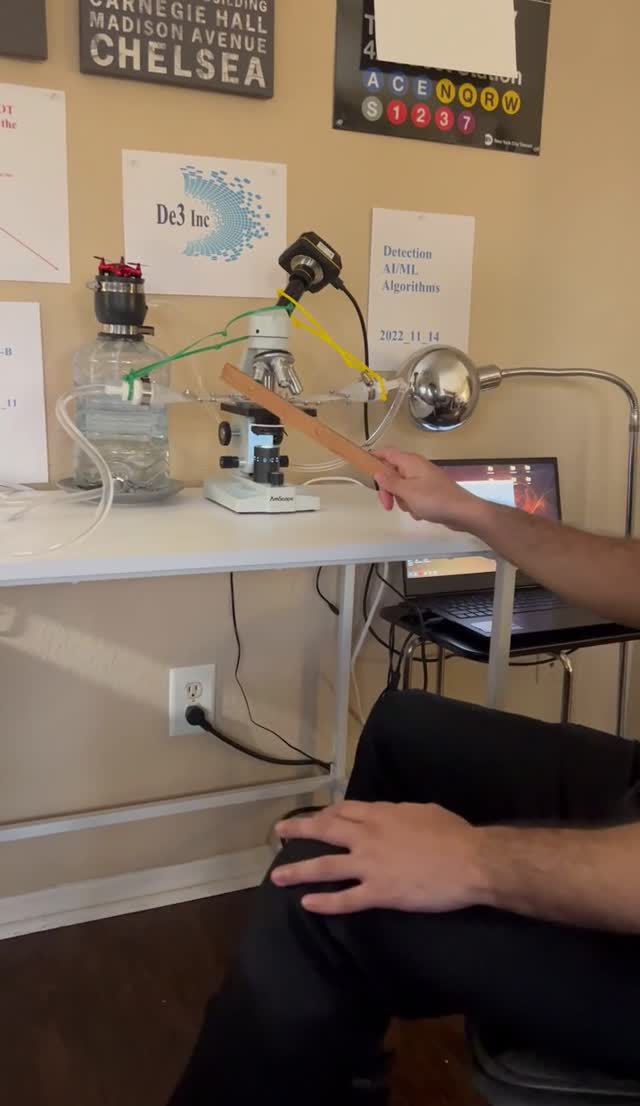
Still frame from included video; not an independently supplied field photograph.
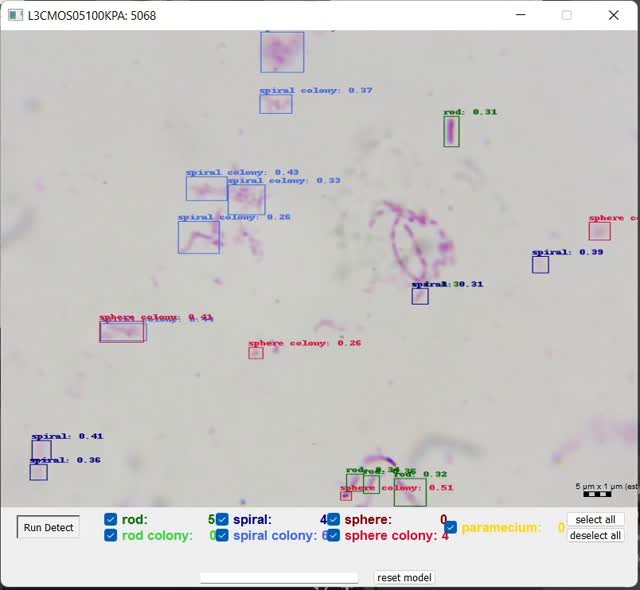
Still frame from included video; not an independently supplied field photograph.

Still frame from included video; not an independently supplied field photograph.

Still frame from included video; not an independently supplied field photograph.
The inventor and founder transferred all intellectual property (IP) and trade secrets to DeTection Inc. Research and development previously conducted through predecessor companies, including DE3 Inc., was also transferred to DeTection Inc. DeTection Inc. is the current corporate entity responsible for the continued development, protection, commercialization, and licensing of this technology.
1. Matter Detection and Microorganisms
USPTO Application 18/141,374 — published as US 2023/0375583 A1 ↗
WIPO Application PCT/US2023/020501 — published as WO 2023/224791 A1 ↗
2. Autonomous Quantum Robotics
USPTO Application 19/532,226 — not yet published (status to verify)
WIPO Application PCT/US2026/014456 — published as WO 2026/198182 A1 ↗
Application filings do not by themselves indicate an issued patent. Current application status and any associated rights should be confirmed against official records.
Confidential know-how may include research protocols, methods, algorithms, experimental records and data practices. This website does not disclose trade-secret details.
Research partnerships and licensing inquiries: contact@detec.ai
DeTection Inc.’s intellectual property portfolio includes granted patents and pending patent applications. The legal status and scope of protection vary by patent, application, and jurisdiction. Patent rights and current status depend on the applicable invention and jurisdiction and should be confirmed against official records.